What makes an image interesting? Why do some photographs look pretty… and that’s pretty much it, while others grab your attention? While there are several devices the clever photographer may employ in service of the goal of creating arresting imagery, one of the most effective, though least well understood, is visual tension.
Wait a minute — tension? Isn’t that something we want to avoid? In life, yes; and it’s precisely for this reason that images which feature a degree of this element cause the viewer to pause and consider the source. When something enters the realm of our senses, our brain upon interpreting this information seeks order, normalcy, calm, quiescence. If something isn’t quite right, our brain triggers our body’s alert system at some level depending on the nature of inconsistency with the norm. This behaviour is rooted in our base biology and served our ancestors well in that, if something was out of the ordinary, it could indicate a potential new food source, another social group’s presence, or an impending situation that could land you on some predator’s dinner plate. As such, visual tension can inspire curiosity, apprehension, wariness, or even panic.
Certainly, a photograph may contain a subject that is shocking, and that creates one kind of tension; however, while that may have merit depending on the circumstances, it’s rather a blunt instrument in terms of artistic expression. There are many more subtle elements of compositional tension that can be utilized to add interest and dynamism to your imagery.
Crop
Last time around, we discussed how creative cropping can be used to save an otherwise flawed image; however, in terms of creating visual tension, cropping is an exceptionally valuable tool in post — just as framing is during the shoot. Take the following for example:

This image features a centre positioned high-key subject; the mood is serene; and there is a sense of balance. Interest is solely derived from the apparent nudity, and the disengaged, yet thoughtful expression on the woman’s face.
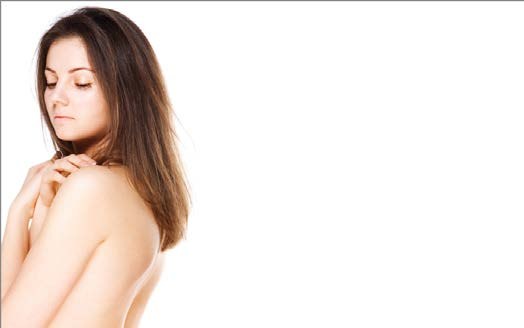
In figure 2 however, we feature a closer crop with the subject placed in the extreme left corner. Tension is derived from the claustrophobic crop — the woman appears to have nowhere to go — and the mood is considerably different from that of figure 1, despite containing exactly the same subject matter.
The emotional context has changed. Figure 2 is definitely more thought-provoking than its predecessor, and the position of the arms against the frame lend more weight to their meaning within the composition.
Shape
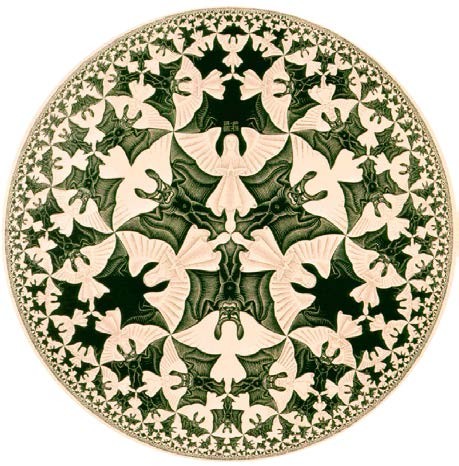
Take this famous example from the creative genius M.C. Escher (his 1960 woodcut of angels and demons): the pleasing symmetry of the pattern formed by the shapes within is what our eye first notices upon viewing this image; it looks balanced and at rest. The abstraction generated by the strong geometry leads you to initially discern it as the composition’s primary feature. However, immediately afterward your gaze will focus on the components which draw you in to discover the inherent tension. Not only is there no negative space whatsoever (i.e. both light and darker spaces within this woodcut are 100% filled with subject matter of equal importance), which leads to an uneasy feeling the more you contemplate it, but the contrast between the angels and demons couldn’t be a starker example of conflict and tension — both in colour composition as well as the obvious mythological opposition.
Similarly shape may be used within the context of photography to emphasize abstraction — which is particularly useful in architectural subjects. If you have a prominent and repeating feature which forms a shape or pattern within a scene, you may highlight this aspect through your exposure, framing, or via contrast. This may have the effect of creating the illusion of your image being one about one thing: geometry, while its components are actually something else, generating interest.
Note that shape can also build tension within a photograph by proposing the improbable, or appearing to present a precarious line. Take a stable, symmetrical pyramid of six blocks: it appears stable and at rest… there is no visual tension. Compare this to the same six blocks in a slightly different arrangement, stacked precariously. Obviously the feeling is quite different — it’s not serene, and though it would still likely maintain its stability in physical space, has considerably more tension due to its disordered and potentially dangerous aspect.
Of Light and Shadow
Throughout man’s history, darkness has been responded to with apprehension. The unseen mysteries lurking within inspire both curiosity and trepidation, as the inherent danger justifiably merits caution. As a result, it has always had an association with evil, death, and the supernatural.
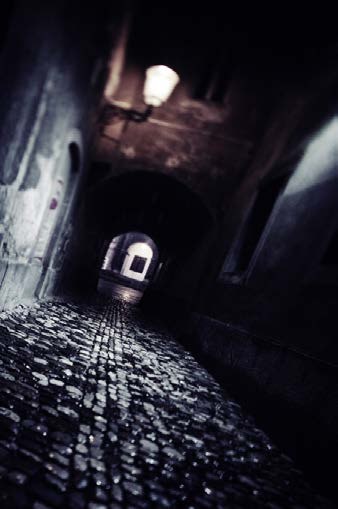
In photography, you may use shadow to great effect in creating tension within a scene. Take the image of a European cobblestone street above, for example. Not only does it create visual tension by leaving the area around the archway completely in shadow, but further increases it by utilizing an off-kilter 45 degree framing. Additionally, the colours have been pushed slightly out of their natural spectrum, lending to the eerie and mysterious quality of this photograph.
Shadowed portions of an image additionally seem to have more mass than those which are lighter. As a result, you may also create tension by unbalancing your photograph in permitting shadows to reside in key areas of interest. If instead our cobblestone passage led through a wider archway to a light and airy courtyard, and the framing was a standard landscape orientation, our eye would be first drawn to the light, and the mood would be one of relative serenity. However, if the shadowed area also contained a dimly lit man staring back at us, the whole tone of the image would change as a result of this injection of tension.
Juxtaposition
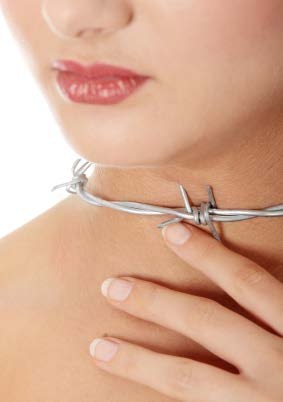
A further tension generating technique involves placing elements within an image which have vastly different or even opposed properties, and blending them into an interesting composition. The image at right highlights the difference between soft and hard, flesh and steel, menace and vulnerability. The tight crop and the exclusion of the eyes also adds to the tension and curiosity generated by this image. Who is she? Is the barbed wire around her neck by choice?
You can juxtapose all kinds of things to get a reaction from a photograph: light and dark, big and small, B&W and colour, smooth and textured… the list is endless; and it’s one of the most powerful tools in building tension.
Finally
While I’ve detailed some fairly obvious examples of visual tension within this article in an attempt to clearly illustrate my points, the examples used are rather ham-fisted as a result. Ultimately, you’ll want to strive to be more subtle in your handling of tension. The goal is to not necessarily make the viewer uneasy, but to draw him in to the image with a whiff of something unexpected. Our lives are filled with enough of the mundane as it is… endeavour to make your photography an engaging departure from that.