
Today we’re joined by Steve Hollinger, Boston based artist and inventor of, among other things, the throwable ball-shaped camera system dubbed the Squito. Thanks for joining us today Steve; maybe you can start us off by telling us how you became an inventor in the first place.
Steve: Thanks for having me. Well, I come from a family of artists; my father was a painter, my mother an art teacher. So I had kind of a creative upbringing, and went through school looking for engineering training. I went into high tech out of college; worked for a number of large companies; and then about 25 years ago went off on my own as an inventor to begin a career developing software and consumer products ranging from large format printing software in the late 80’s and early 90’s through creating products for kayakers, and a wide variety of other products. So a pretty mixed career.
As far as photography goes, I have a lot of background in colour imaging — I worked at Wang Laboratories back in the 80’s in their imaging department, and worked at a company called Telex on colour printing. Then I developed a product called ‘PosterWorks’, which was the first desktop large-format production software back in the day of Quark Express and Pagemaker. So back then, 24 bit colour and colour separation technology was just budding on the Macintosh. My product was the first to allow people to do high quality production of billboards without a real loss of quality, up to 250,000 square feet. I had a patent filed for that product, which would allow a photograph to be enlarged to these extremely large sizes again without a loss of quality. The way that worked was the software is that for example an eyelash is high frequency in a person’s face, and a cheek is low frequency… it’s smooth. So the software would actually vectorize the high frequency parts of an image and then interpolate the low frequency parts normally as you would in Photoshop…
DP: So, as a raster graphic.
Steve: That’s right. And then later on after it had scaled up the image, with the interpolation of the low frequency data, it would carve the high frequency data back in. So it was a pretty cool patent, and a great product.
DP: It sounds like you did quite well with it also. So, you’re also an artist… would you say you’re an artist or an inventor first? Or would you describe yourself differently?
Steve: Well, it’s hard because I actually do both. I work as a sculptor, and show my work in galleries. So I do work as an artist and enjoy that life also. I don’t feel I’m one or the other. I’ve managed to kind of find time to make sculpture and also to live a life as an inventor. Usually I draw a fairly clear distinction between things I’m working on that have a commercial intention — and generally speaking, when it has a commercial intention, when it’s an invention that I want to market, I look at it a little differently and see it as something where for example I’m willing to make more compromises based on what customers or the market wants. With art work generally, your intention is not at all related to commerce; and it comes from somewhere deeper inside. As an artist you’re usually less compromising, so I feel like my art work is a completely separate part, and each side informs the other.
DP: So do you spend an equal amount of time on the inventions versus the artistic work… or what percentage would you say you do?
Steve: That’s a good question. I think over the years it’s varied. For a while I was doing more sculpture and really trying to look at how to show work and work closely with galleries, but then realized that my business which I had developed for quite a while was kind of getting somewhat anemic, and I was worried that I hadn’t concentrated on the business side. So I scaled back my art work and concentrated on the business for a few years, and that’s kind of where I’ve been at for I think the last three or four years — working really hard on the business side. Now I have two shows coming up this year though, and so I’m looking forward to getting back in the studio more.
DP: Well that’s great! Now is it the case that your initial commercial success afforded you the ability to pursue your, maybe not as commercially viable artistic endeavours, and that’s why you let the business side of things kind of slip a bit?
Steve: I think that there’s some of that. It’s fair to say that as an artist it’s difficult to actually make a living and live in an urban centre, primarily because in the art world generally, unless you’re really into the marketing angle, there’s either the cream of the crop — the top 5% of artists, or maybe the top 1% — and then there’s everyone else… most are struggling. Most of my friends and I are working really, really hard. So it’s tough; there’s a tension always between wanting more studio time, and also wanting to do some of the things like paying the mortgage or doing the normal things in life. As an artist you’re driven; you don’t want to do anything else, but you also have to make some compromises along the way to try to put your financial house in order. So I do a lot of commercial stuff to deal with that side of things so I don’t have to compromise on the other side.
DP: I see… that situation certainly exists in the photographic world as well.
Steve: It sure does.
DP: So, speaking of the photographic world, maybe you can tell us a little bit about the Squito… what was the genesis of that product idea?
Steve: Sure. I’ve been working on Squito for quite some time. The concept has been evolving probably in earnest for about 5 years. I filed the first couple of patents on it back in 2009. When you’re an inventor you actually have a lot of irons in the fire; and usually you’re working on one that’s in the market, and maybe you have a bunch that aren’t that you are working on separately. So I’ve been working on this thing for a while now, and basically the concept is that if you throw a camera in the air — and especially if it’s spinning around — it has an incredible view of the universe. It’s actually more exciting than you might even imagine; because, when you see the data that comes off a camera that’s been thrown in the air, it’s startling to actually discover what you’re looking at. First of all, in the photography world right now, people think of photography as 2D, and maybe they think of 3D panorama or 3D stereo… but the reality of what’s out there is different. The reality is what your eyes see and what happens when you turn your head around: it’s neither a spherical panorama, or a 2D stereo image. So the data that’s available is massive and really interesting… and the question is: how do you represent that? How do you capture it? How do you provide it to a user in a really interesting and useful way? So these are all problems that are really fun to solve and work on.
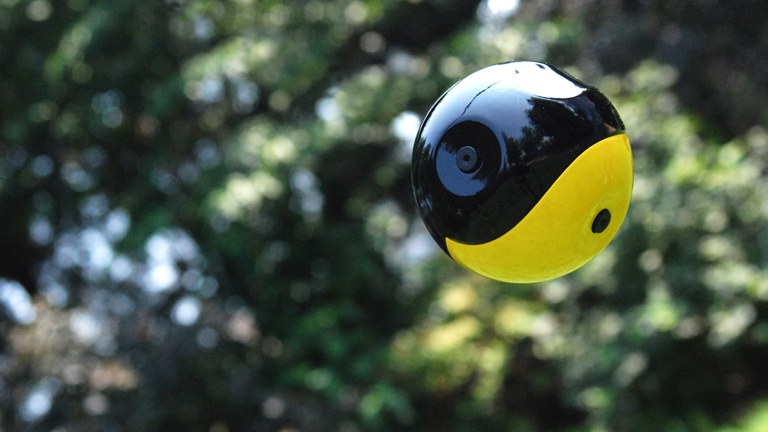
If you think about what your eye is seeing, that’s not exactly what you’re representing when you’re handed a JPG, or TIFF, or a movie file. There’s no format out there that actually represents what you see. So one of the problems when you have the idea of throwing the camera in the air and trying to capture data that’s just available, it’s a whole new way of thinking. Anyway, to simplify, the Squito’s basic premise is that you can make a camera that can capture spherical panoramas by throwing a ball in the air. It can have a number of cameras embedded in the housing, or if it’s spinning fast enough, it can capture all the data using a minimum number of cameras.
DP: So, ‘Squito’… where did the name derive from?
Steve: You know really I like coming up with trade names for these products. I started working on the housing for the camera, and the early versions looked a little like a trilobite. So I was looking for names that were like that: Trilo etc. Then, as the housing evolved a little further, it looked a little more insect-like when you threw it in the air… so I thought about Mosquito, and then Squito just came from that. Also, the nice thing about the name Squito is that it’s kind of playful, but also for more serious applications, it still has meaning. It’s not one or the other.
DP: So, how does it work? Can you explain the order of events that occurs once the camera is thrown?
Steve: Well I can’t exactly explain the order of events based on the interface or anything like that because it’s not a real product as yet; it’s in development. The product as it evolves could be a number of things: there could be an application for recreation and there could be a version of Squito for, let’s say, search and rescue or something more serious. So at the stage you’re developing an interface, I think you’re kind of much further along the product development way than I am. I’m working on the control software, the logic for how it knows where it is in the trajectory and the basic camera triggering… some of the logic involved with how it’s going to be working with stitching of multiple images from multiple cameras… so there’s a lot of work that still needs to be done. It’s pretty early.
DP: So is it going to be triggered by an accelerometer when you throw it up, or some timer device? Do you have that nailed down yet?
Steve: Well I have the prototypes that use a triple axis accelerometer, a triple axis gyroscope, and a triple axis magnetometer. The magnetometer is actually there for doing some correction or error in the other micro-components. So basically it knows where it is in space, it knows the direction it’s looking at.
The patents are really the basis of what I’ve been thinking about, and they describe a number of different opportunities: you can either trigger cameras based on knowing what the camera’s looking at, or you could capture everything and then extract from what you’ve captured. In other words you have a standard video camera embedded in the Squito, and then you are actually using the accelerometers and gyros to tell you what to extract from the capture information later. On top of that you have the ability to rotate or transform the image data from one orientation or perspective to another, to supply it to the user in a useful form. So, for example, a ball thrown in the air, you want to supply the data back to the user so that the earth is on the bottom and the sky is on the top; so the ball can use the sensors to figure out what orientation it should rotate the data to. So there’s a lot of uses for these components in the Squito, and each application will have whatever set it needs to get the job done.
DP: So what applications do you see it having?
Steve: Well, you know, it’s funny because every day I hear more applications that I didn’t think of. So, I think I probably know a tiny fraction of applications that it will actually end up being used for. The ones I’ve been thinking of are really recreation, just for having fun, a low cost ball hopefully — let’s say $99-$200 — and then again a low cost ball, believe it or not, for search and rescue. For more serious applications I’d like to get a low cost ball out there, because I think there are situations where it may be difficult in some cases to get the ball back. For example if you’re a firefighter, you might want to be willing to throw away $200 to save somebody. So I envision fire departments having a sack full of cameras that they can throw into a burning building and then try to get people out if there’s someone in there, and otherwise save a firefighter’s life by not having them enter the building.
So, obviously there are people who are interested in military applications, and tactical applications… things like that. I don’t have much experience in that world, so I probably will work with people who better understand what the needs are for that space. Generally my interest is in a consumer product, a high-end professional product, and a low to mid-range cost search and rescue product… those would be the three I am concentrating on. The applications that are intriguing are architecture: fly-throughs and overflights of buildings for real estate. You even have people like storm chasers asking me to make balls that they can throw into a storm… there’s a pretty wide range. There’s a lot of mapping stuff out there also. Let’s say people are making a 3D movie, and you are actually creating 3D simulations or CGI versions of creatures or whatever, and you want to map the specular reflections of an environment to that creature. It’s really hard to get 3D spherical panoramic data to map specular reflections onto a computer generated object. So the Squito could help with that.
DP: So, on the prototype, how many cameras are actually inside, and what are their characteristics?
Steve: The actual Squito that I’ve shown publicly has three cameras. I haven’t published specs for those three cameras at this point. I’m not really willing to disclose publicly what I’m doing since we haven’t nailed down the application or the actual components we’re going to go with.
DP: Ok, well in terms of interfaces, how do you get your images back out?
Steve: Well, the intention is to have wireless transmission. However, because of the cost-prohibitive nature of wireless, there may be a low cost Squito where you’d have access to some kind of port. So like a GoPro, you’d plug it in through USB. You know, wifi is fairly short range, so wireless, if it’s going to be in there, has to be workable so it makes sense for a longer range than normal use of wifi. Again, these are decisions based on each particular application. If I sound a little wishy-washy it’s only because, you know, I’ve done a really good job nailing down the research, the history, intellectual property — the patenting part of it, and also generating prototypes that are workable enough to prove that I am onto something, but we’re not at a stage close to going into production with this. I still probably have to go through a round of financing or finding a camera company to work with to actually get it into production.
DP: On the video of your prototype in operation you describe the unit interfacing with others… what’s the application of this type of networking?
Steve: With other Squitos?
DP: Yes, other units of the same variety…
Steve: Well, that is a really exciting area. In fact, I have a feeling, if it hasn’t been done already (and I’m not sure; it probably has), but as far as these kinds of balls go that you throw in the air, there’s a lot of exciting stuff that they can do when they start communicating with each other. I mentioned earlier that when you look through your eyes, you see a world that you actually don’t represent or capture when you use a camera. When you start using multiple cameras to capture a scene, the data becomes really bizarre and interesting. For example, you could throw one ball on one side of a motorcycle and one on the other side… and now you have both sides of the motorcycle available for you to pan from one ball’s camera to the other smoothly through space, and represent all sides of an object. That’s pretty interesting. You could throw 50 cameras into a room; map the room; map all sides of everything in the room; and then have some way of interacting with that space.
I’m sure I’m not the only one working in this area. Technically it’s called SLAM, which is simultaneous localization and mapping. There are people working in this area for cameras that are on tripods and maybe even on helicopter drones. So I think there’s a lot of technology converging here; but I am probably the only one working on it with throwable camera technology.
DP: Now in the area of search and rescue, would you say your primary advantage over drones would be the cost factor?
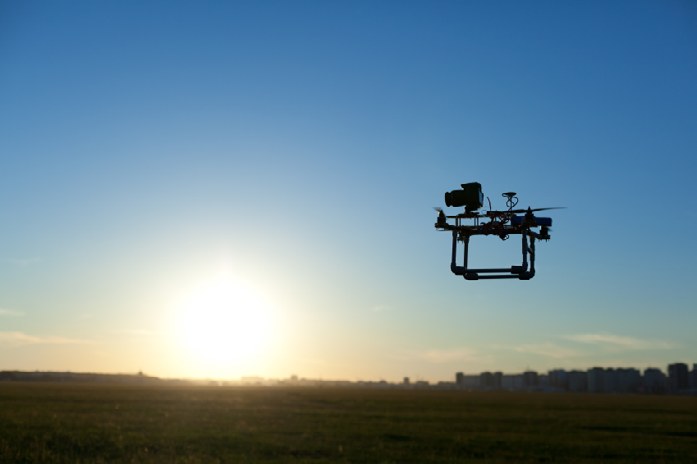
Steve: I think I have a significant advantage over drones way beyond cost, but that’s a really big one. Cost is going to be the biggest one. All things considered, when I finish this thing, we’re going to be able to produce cameras at pretty low cost — even if let’s say it has one camera in it, and just produces enough data while it’s being thrown somewhere to provide something back. If you imagine a bucket full of balls, a bucket full of marbles that have cameras in them, you can get the price down to where it’s really cheap.
Yeah, price is a big issue; but the other advantage of a throwable camera over a drone is first of all, let’s say you want to go through a forest, and you have big evergreen trees… it’s not easy to be managing a flight of a helicopter, no matter how big it is — even if it’s insect sized — through something that dense, something where you have to deal with really complicated interferences. With the ball, you don’t have to worry about that at all.
I talked to a guy earlier today about this, because he’s dealing with drones, and the amount of legislation that’s coming down the ‘pike to deal with photography from drones is substantial. Anything that self-sustains flight is considered a drone… and so anything that has a motor that propels it is going to be regulated. I don’t have to worry about that regulation, at least as far as I can tell. The throwable camera isn’t self-sustaining in flight, so it’s basically just like any other camera.
DP: Ok, so back to your prototype, we know it’s ruggedized, but what kind of stresses can it endure? For instance is it waterproof?
Steve: Good questions. Well, the prototypes I’ve made so far, and again, these are kind of final design questions, so obviously a housing can be made that is waterproof. I’ve made multiple housings and one is close to waterproof — most are not. Again these are prototypes, not final design, so will the final be waterproof? I would suppose it’s likely. Or you could have something like the GoPro, where you have an option for a waterproof casing.
With cameras now we can have 100% solid state components that are impact resistant; and I’m trying to nail that piece down: what components would not be able to sustain high G’s… even from a baseball bat. So I would like to say to you it’s doable, and I think I’m going to try to get to where you could hit a camera with a baseball bat, but I haven’t done that yet. I have got specs on each of the components I am using, and they each can sustain many Gs of force, so for a bouncing ball, not a problem. It’s surprising if you read the specs for these gyros and accelerometers what they can take though… it seems to me that they can probably handle being smacked by a baseball bat. They just need to be enclosed in a casing where you’re not breaking the solder leads or damaging the chip; but I think they can handle it.
DP: Well that’ll be really interesting to see where that goes.
Steve: These are really fun problems to solve I think, aren’t they?
DP: Definitely! So you mentioned you are a programmer and you worked at some large companies… did you have a background in electronics before you started this project?
Steve: No I didn’t, and I still don’t actually. I am a kind of inventor when it comes to logic hardware, I usually do experiment until I either get something working, or it smokes. So basically, I am not an electrical engineer. I have a strong software background, and I’ve retained those skills, so I think I’m still a pretty good programmer; but I depend on other people to help me with the logic. So I’m weak in that area, but I have picked it up. For example for prototyping I did a lot of the Arduino microprocessor programming, and I’m moving now to checking out some of these more hobbyist technologies like Raspberry Pi and things like that. So I did all the early work programming my own boards and doing all the soldering and stuff to get all the IMU (inertial measurement unit) stuff working — the gyros and accelerometers — I did myself. Anyone can do that right now. You could go right now and buy off-the-shelf gyroscopes and accelerometers for a robot drone, do the soldering with maybe a day of practice, and have it working within, if you do basic programming, a couple of weeks. A lot of it is available through open source, and the learning curve on this stuff is really fast and easy. It’s surprising!
DP: Well maybe you’ve just inspired people that’ll be reading this content and will go out and try some of that themselves.
Steve: Well sure. I’ll give you a couple of tips. DIYDrones.com has an amazing website for people in this community of either photography or just hobbyist drone work. There’s a lot of open source ideas there and it’s really a great sharing community. Then, for any inventors out there, a great resource for me has been mfg.com. That site is really cool, because if you have any idea that you want to make something, but you don’t know how to go about it, you could even make a drawing in Adobe Illustrator or Photoshop, and you throw it up there on that website, and if it’s reasonably sophisticated enough so that people can understand what the measurements are and so on, they’ll bid on that job around the world. It’s always competitive, and it’s just amazing. So that’s an opportunity for inventors to just do their own thing.
DP: Well I’m certain that’s going to be intriguing for a lot of our readers actually. Now, I’m sure you have a lot of product ideas swimming around in your brain; what’s your criteria for pursuing one?
Steve: You ask good questions. I have a lot of ideas I wish I was doing right now. So, I feel a little frustrated. I think that that frustration is part of the game and what’s really kind of funny is, the portrayal of the life of the inventor is probably a lot more romantic than actual reality. It’s a really tough job. For example, one of my inventions is a kayak light. I think right now it’s either the top selling or second to the top selling kayak light on the market. It’s patent pending and it’s got a great way of attaching itself to a kayak. It’s available on Amazon, and is pretty well known. I manufacture that myself — I get the parts from around the world and assemble it, and because the sales are still ramping up, I make it myself. So I dedicate a day a week to making kayak lights or making parts for kayakers and boaters. So I’m still here making kayak lights that are starting to sell at a rate that I’m almost becoming a little angry when they sell! It’s kind of hard to say that, but…
DP: Because it’s diverting you from other projects.
Steve: It is, and it’s hard for me to move that product to the next level, which is finding someone else to make it. So I actually have to move that product to an assembly company which is a hard step because one of the things people love about that kayak light is the quality control is top notch.
DP: Well that’s a happy problem to have I suppose…
Steve: Well, it’s got its plusses and minuses, but it’s a little frustrating.
DP: Yeah, well I can appreciate how that might be the case. So you’re talking about how it is tough to be an inventor, what kind of person do you think it takes to become one, and would you recommend others pursue this path?
Steve: Um, I’m a little scared to recommend it. I once said to a guy like twenty years ago that I recommended it, and he told me the next day he had quit his job. So, my heart sunk because I’d just told this guy it was a great job and he’d quit his. I don’t want to suggest to people that it’s an easy job; I think more likely, if it’s in your blood to be your own boss and do your own thing, it’s hard to do something else. It becomes almost like you don’t see any path in another direction. I do encourage people though generally to follow their dreams; I would just say it’s not easy. It’s like when you have a kid, a significant portion of your life is dedicated to that, and that’s what it is. It is an occupation that really is consuming.
DP: Now, we’ve noticed that some of your inventions other than the Squito have photographic applications, like the kayak mast for instance. Are you a photographer yourself?
Steve: I am friends with many, many commercial and fine art photographers, and I know enough about how great people are to never put myself in their camp. So, the one thing I would say is, yes, I love photography and I’ve been working on high tech photography projects for 20+ years… I still am not a great photographer, comparing myself to people that I am friends with that are in that field. So even though I love the technology and learning about cameras, I’m more of an amateur.
DP: Ok, so you’re friends with a lot of high-end photographers; does your interaction with them inform your inventive process as far as your photography related products go?
Steve: Absolutely. I get a lot of my understanding of what their needs are from their experiences. Boston is a great town — it’s tough to make a living here as a photographer, but it’s a great town for photographers, and we have a fairly strong commercial photography community. Also, my neighbourhood of Fort Point in Boston is one of the largest arts communities in New England. We have a lot of fine arts photographers here. So to answer your question, a lot of my ideas come from this kind of creative energy which exists here.
DP: Well that’s great to hear. So, when can we expect to see the commercialization of your prototype? Do you have any kind of timeline in mind?
Steve: I think that the next step for me is probably assembling a team of people who are more capable at some aspects of this thing than I am. Because I have to get to the next level, it’s probably going to involve a round of financing that’s going to require some more business oriented work. So it’s going to be a while. It’s one thing to have a prototype and working software, it’s another to actually make decisions about what cameras to incorporate, what logic and what technology to go with. These are fairly lengthy steps.
DP: Anything else that we can expect to see coming from you that you can share with our readers… different projects you’re working on?
Steve: Well there’s a related project called the Darkball that’s going to be similar to the Squito but operating at night and in the dark. So that’s kind of an exciting area also. So the convergence of technologies I was talking about earlier includes high speed cameras, which we’ll probably be seeing a lot more of in the future. The price is coming down in high speed photography which is really, really exciting. As you have cameras that are capable of in normal lighting conditions taking very high speed pictures, it makes the throwable camera that much more viable. Well the same thing goes for infrared and thermal imaging. The ability for example for a firefighter to throw a camera into a smoky room and receive an image of what’s in the room — seeing through the smoke — is pretty exciting.
DP: So are you looking at obtaining financing for both products concurrently or is that a separate thing entirely?
Steve: I think it will probably be concurrent because they both share a lot of the technology, the main differences being just the imaging sensor. So a lot of the internal workings of, for example, the rotation or stitching of an image, that stuff is all shared. There’s definitely demand and excitement in both markets. I’ve known about this for a few years now, but I’ve kind of kept a low profile. It’s been pretty obvious that there’s a strong market for it.
DP: Excellent. I guess the housing would be of a different grade from the recreational model.
Steve: Yes, the housing would be different, its looks, how you hold it, how you throw it, are all going to be different. In fact, more recently I’ve been moving toward for some of these markets, non-spherical models. That’s also an interesting thing to think about: the aerodynamics of non-spherical objects. I worked for a while inventing a wide variety of umbrellas, believe it or not. For aerodynamic conditions testing I even went to the MIT wind tunnel with some of my prototypes. What I learned a lot about is how you can move things through the air. For recreation it’s one thing, you probably just want to throw a ball… but a ball is not especially aerodynamic. It’s considered a bluff body shape which generates a vacuum behind it, or let’s say a low pressure area behind it.
You can imagine there are shapes faster than a ball that you can throw with your hand. That doesn’t mean a person for recreation wants to be playing catch with a friend at 95mph. But you can imagine other applications where it would be nice to throw an object that reaches a very high velocity. So that’s another area I’m looking at: alternate shapes for the housings.
DP: That’s fascinating. Thanks so much for your time and we certainly look forward to getting our hands on a Squito once they are available!
Steve: Well you are among the first to contact me and you’ll be among the first that I contact when it’s available — so thanks for enquiring!