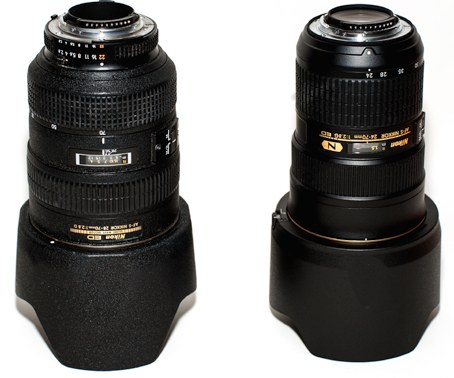
Since the advent of full-frame digital cameras, my venerable Nikkor 28-70mm f/2.8 (which originally debuted in 1999) has been the go-to lens for a large portion of my work; and indeed is the glass that lives on my body until such time as another is temporarily swapped in. So, you may be surprised that I didn’t immediately jump on the bandwagon as soon as the updated version, the 24-70mm f/2.8 was released by Nikon.
Well, for starters, the 28-70 is a brilliant lens, and I wasn’t convinced that the 24-70 would be improvement enough to warrant the expenditure of another couple of thousand dollars… so I held off. Sure, there were a couple of extra mm at the wide end (but I have a 17-35 that covers that range beautifully) and it used the new nano coating… but was it really going to be so much better than my old standby? I figured of course I’d eventually switch; but, I kind of just never got around to it, as I was so happy with my 28-70 — there being so many other enticing photographic products to spend my money on.
I was therefore extremely curious when Nikon shipped us the D600 (also reviewed in this issue) to evaluate and included the 24-70mm f/2.8 as part of the package. This seemed the perfect opportunity to run a head-to-head test to see whether my reluctance was prudent or simply foolish.
First Impressions
One of the few complaints people seem to have about the old 28-70 has been the fact that it’s big… and certainly it does come by its nickname ‘The Beast’ honestly. Frankly the size never bothered me, but I was surprised to see that despite reviews I’d read about the 24-70 being so much more compact, it was a slight 35 grams lighter (at 900g), and only of marginally less circumference. So for me, there’s really little difference here.
Of course, the next most obvious difference was the lack of an aperture ring on the 24-70, it being a G lens. Well, that’s fine for most folks who have only modern equipment; however, I own a few older film bodies that my 28-70 works fine on… and it’s simply not an option to mount this new lens on my old gear. Is that a showstopper for me? Definitely not. How often do I shoot film anymore… once or twice a year? If that. Your own circumstances will obviously dictate whether this is problematic for you.
Run Down
Like its older brother, the 24-70 features 15 lens elements in 11 groups, with a 9 bladed diaphragm for rounder bokeh, supporting apertures from 2.8 through 22. However, the 24-70 also sports Nano Crystal Coating (more on this below), a closer focusing distance of 15 inches versus the 28-70’s 27.6, and better dust/weather sealing. Additionally, the 24-70 includes three aspherical elements, unlike its predecessor’s one — improving resistance to wide-angle distortion and other types of lens aberration.
In Practice

For testing the two lenses head-to-head, we decided to affix them to a well tested and reliable D3 in turn, using a tripod and cable release to ensure consistency. What we used for our initial subject matter was a stone wall in order to measure corner sharpness at various apertures. This would allow us to have enough variability in the surface to adequately distinguish detail differences between the lenses across the range.
Since the advent of digital full-frame, vignetting has again become a factor to consider, and of course the 24-70 and 28-70 perform about equally well here, with noticeable effects from wide open through about f/5.6. Since this focal length is often used in portraiture however (where you might actually want to add vignette in the first place), it certainly isn’t a primary concern… and as most lenses exhibit this quality, isn’t something you can get away from anyway — unless you select DX mode. The 24-70 seems to render images slightly warmer than the 28-70, but in most situations the effect is pleasing and of course can be adjusted in post if need be.
Sharpness
For me the key metric that would be the deciding factor on whether I would purchase the 24-70 is definitely sharpness. As mentioned, I have been very happy with the 28-70 in this regard and was a little skeptical as to whether the 24-70 would outperform it to such a degree as to make a purchase decision obvious.
Well, I was certainly surprised with the results. Not only did the 24-70 best its older sibling in corner and edge sharpness wide open, but centre sharpness as well… and this is with the latter lens having had the benefit of micro-tuning afforded by the D3. This isn’t to say that the 24-70’s corners are tack-sharp… indeed, there are issues through about f/4. However, they are definitely sharper than the 28-70’s; and what I thought was a sharp centre, wide open on the 28-70, turned out not to be the case when compared to its younger brother.
Stopped down to f/3.2 however, the centre sharpness differences began to disappear — though the 24-70 was as sharp at f/2.8 as the 28-70 was at f/3.2! The 24-70’s area of corner softness was also smaller than that of the 28-70 — a welcome surprise.
Nano Crystal Coating
Initially introduced on the Nikkor 14-24mm f/2.8 ultra-wide zoom, the Nano Crystal Coating is also featured on the 24-70. Designed to reduce ghosting and flare (a result of reflections inside the lens barrel when light enters diagonally), this coating will likely be incorporated into all future pro lenses that feature wide-angle focal lengths.
According to Tsuyoshi Murata, one of the coating’s primary developers, “The word ‘nano’ denotes one billionth. Although the term evokes an image of hardness and precision, the reality is completely the opposite. The actual grains that comprise the material are extremely small nano particles which are arranged in a spongy construction, rather than being tightly arrayed. This coarse structure, which is in complete contrast to the densely packed composition of existing coatings, is a major strong point of the material.”
Ok, well, that’s interesting; but what does it mean for photographers? We tried to purposely create flare in several images using the 24-70, but never achieved anything like what we were able to pull off with the 28-70. The bottom line? This stuff works. Of course, if you are trying to create flare for artistic reasons, this mightn’t be ideal… but hey, isn’t that what Photoshop filters are for?! (just kidding).
Conclusion
The Nikkor 24-70mm f/2.8G ED is better in nearly every conceivable way than its predecessor, the 28-70:
- 4mm wider
- Sharper both in corner/edge and centre areas wide open
- Lighter
- Closer focusing
- Better flare and ghost resistance
- More weather/dust resistant
Its only weakness is the lack of aperture ring — which as mentioned, isn’t at all an issue for folks who aren’t interested in using it on very old gear. So will a new 24-70 sneak its way into my camera bag in the near future? Definitely.