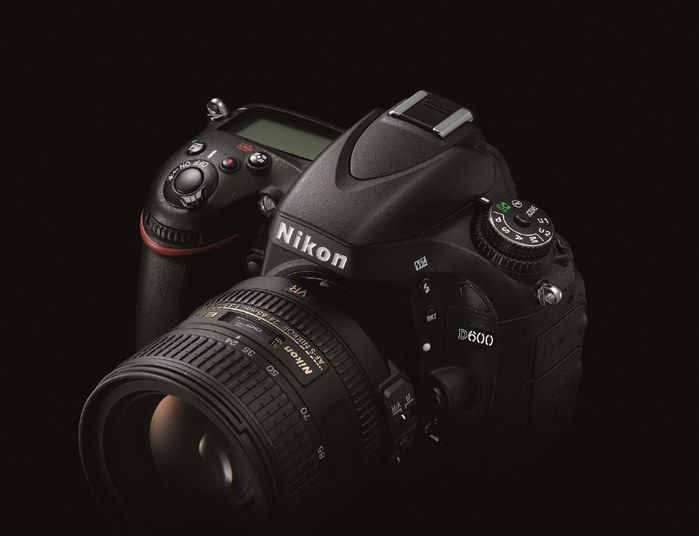
When the new Nikon D600 was announced, we couldn’t wait to get our hands on one to run it through its paces — and happily, the company was willing to oblige. The package we received contained both the D600 and the Nikkor 24-70mm f/2.8 lens (also reviewed in this issue), and having thoroughly tested them, we are eager to share our results with you!
First Impressions
The lean body of this full-frame, 24.3 megapixel camera, belies the power that dwells within… yet, while lightweight and compact, it still has enough heft to make it feel substantial and comfortable in your hands. Ergonomics, as is usual for Nikon, are given significant attention in the D600, which features well laid out controls, generally easily accessible without having to take your eyes away from the viewfinder.
Of course you get all the things you’re accustomed to on a Nikon DSLR body, however there are a few differences in how they’re delivered. For example, the mode and release mode dials are both of the locking variety; and while this is a boon for those prone to accidentally changing from one mode to another, we found the lock button on top of the mode dial a bit difficult to get used to — particularly for those with larger fingers. This however proved only a minor inconvenience.
Another difference that was a bit of a disappointment was the lack of ability to have the image review function zoom to 100% by pressing the ‘OK’ button. We use that feature all the time, and while you can certainly zoom via the combo buttons, it isn’t nearly as quick as simply hitting the OK to see if you’ve nailed focus at the crucial point.
In addition to the usual manual, aperture priority, shutter priority, and program modes, the camera includes tons of scene modes (children, landscape, sunset, indoor party, etc.), and also full auto for the novice or those just getting their feet wet in the DSLR world. Introduced in the D7000, the D600 also features two user modes which are directly accessible via the dial, enabling you to instantly select all of your stored shooting settings for either. This is a fantastic addition which saves the photographer from having to hunt through menus; and we would definitely welcome its inclusion on future bodies from the company.
The D600 also includes two SD card slots which provide the ability to automatically backup to the second card, overflow to it once the first is full, or store JPGs on the second and RAW files on the first. Though we are no fans of SD cards period, given their inherent fragility, it’s great to see a consumer/prosumer level DSLR provide this functionality, once only available in pro bodies. The files it stores are quite large however (27-28 mb each), given the 24.3 megapixel sensor… so be prepared to have some laggy performance in post, unless you have some serious computing horsepower under the hood.
In Action
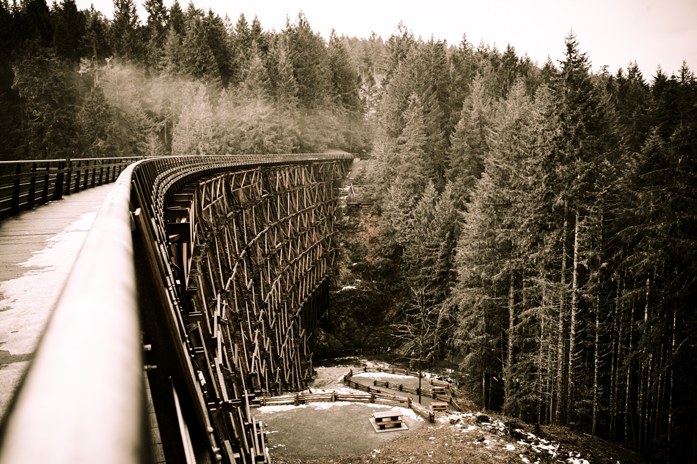
To put the camera through its paces we decided to take a trip to the Trestle Bridge near Shawnigan Lake on Vancouver Island. The weather was grey and foggy — perfect for some desaturated, split-tone, and black and white architectural photography. The camera performed admirably; exhibiting good dynamic range, with well preserved highlights and shadows, excellent metering, and snappy focusing. One thing we did notice however, is that despite the camera’s purported 100% frame coverage through the viewfinder, we discovered it to be very slightly less. We originally chalked this up to user error, but tested it back at the studio and confirmed our findings. The only reason we noticed at all was the fact that we were doing architectural shots, and trying to put specific elements of the image exactly in the corners of our frame. Perhaps the unit we received for testing was a little off. In any event, this will matter little to most and, the tiny excess can always be cropped in post.

For our colour tests, we photographed the Nanaimo harbour. The auto white balance, typical of Nikon’s later bodies was dead on… in fact, I can’t remember the last time I used anything other than auto outside of the studio. Colour rendering was very accurate, though using the ‘Camera Landscape’ profile in Lightroom could over-accentuate blues in certain situations as seen in the accompanying image. Of course this is easily compensated for, and in general, this body delivers some of the most faithful colour reproductions we’ve ever seen.
The shutter is quiet and responsive, and boasts speeds of up to 5.5 frames per second, supporting operations at 1/4000th to 30 seconds. The release mode dial also features a ‘quiet’ function, which frankly we found mostly useless, given it is pretty much as loud as the camera’s normal shutter operation, and simply seems to draw out the sound for a longer period as well as completely blacking out the viewfinder. Flash sync speed is also a little disappointing at 200 vs. the standard 250, but there again, most folks won’t notice.
Unlike some of its predecessors, the D600 is compatible with nearly the entire line of Nikkor lenses, with only the very oldest and lamest among them excluded (IX NIKKOR lenses (why you’d want to put one of these on your DSLR is beyond us), lenses for the F3AF (no problem unless you were a press photog in the early ’80s), and non-AI lenses (do you have a lot of pre-1977 lenses kicking around that you’re dying to use on your new DSLR? You can convert them to AI yourself if you’re handy — plenty of how-to’s on the Internet)).
The focus system employed in the camera, Multicam 4800, employs 39 focus points — all clustered at the centre of the frame. This configuration requires you focus and recompose fairly often; however it didn’t seem inconvenient and just took some getting used to. It’s extremely accurate and fast in decent light; we did however find it hunting a bit in low light — particularly in video.
Video
Nikon’s DSLR video efforts have definitely improved with every generation of body they’ve released. The D600 is no exception. Simply flip the rear switch to Video mode, activate Live View, and click the dedicated video record button to capture up to 20 minutes of video at the highest quality setting, featuring full 1080p at 24, 25, or 30 frames per second. Additionally, the unit will shoot 720p at up to 60 fps! There is a built-in mono mic for audio capture and support for the addition of an external stereo microphone which delivers substantially better sound reproduction. While the built-in microphone is great indoors, wind noise can be problematic outdoors; the addition of an external microphone (such as the Nikon ME-1, around $179) substantially reduces this difficulty and greatly improves overall sound quality.
Conclusion
It’s not every day that you find so much photographic punch squeezed into such a compact format; and despite a few minor quibbles we had with it, the Nikon D600 delivers just that. A steal at $2179 MSRP (retailing as low as $1997), we highly recommend it.