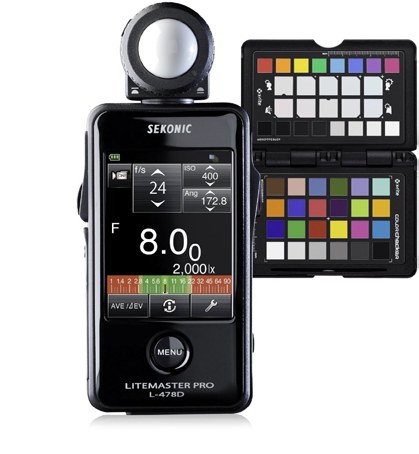
Having used hand-held light meters for years, we are always excited to see new advancements in the technology; after all, anything that makes working as a photographer easier is always welcome. That being said, we have to admit to feeling a little incredulous about Sekonic’s new meter, the L-478DR, touted as being the world’s first to feature a touch-screen interface. We wondered if any additional utility would actually be gained by the implementation of this technology, or whether it was simply eye-candy designed to entice the buyer. Certainly, it has the ‘Ooooh shiny’ effect on photographers; but we wanted to see what actual benefits it conferred. To this end, we contacted Sekonic who were kind enough to send us an evaluation unit to put through its paces.
First Impressions
Upon opening the box, we were initially surprised at just how small the unit was. It fits perfectly in the palm of your hand, measuring 57mm width x 140mm length x 26mm depth and weighing in at only 140g (2.2″ x 5.5″ x 1″ @ 5oz), and promised to deliver much for such a diminutive meter. Powering it up takes a few seconds while loading the operating system and user configuration, and then you are greeted by large, easy to read interface elements, clearly designed to make operation as intuitive as possible. While originally concerned about the display’s readability under bright sunlight, we are happy to report that it suffers little from such conditions. Additionally, the manufacturer has included an anti-glare film that can be placed over the screen, further improving this performance characteristic.
Adjusting aperture, or shutter speed settings is done via tapping or sliding your finger/thumb over the appropriate interface element, behaviour anyone owning a smartphone or tablet will be well acquainted with. The screen is not however, as sensitive as an iPhone’s (for example), and will take a little getting used to for those more familiar with the operation of the capacitive screens found in those devices. Further, as the control for adjustment of shutter speed or aperture (depending on what mode you are in) also displays its current value within the same element, you may find your thumb obscuring it should you use that digit to input your settings. We found this particularly true when adjusting aperture. Of course this is a minor concern, simply rectified by using your finger instead, though perhaps having the option of displaying the value below an adjustment control rather than within it might have been a better way to go here. This brings us to a realization however: obviously this is one area where a touch-screen interface is superior to static physical controls, as implementing alterations like the suggestion above may be made by simply updating the operating system.
Software Stability
Speaking of updates, Sekonic has included software which automatically detects and informs the user of their availability — very handy. While we never had any issues with the software onboard the meter, we had less success with the update functionality of the Mac desktop application. Despite it indicating the fact that updates were indeed available for both the desktop app and the meter, it failed to update the app despite 5 attempts, and took 3 tries to get the firmware updated on the meter. Additionally, we had to manually terminate the app using the Activity Monitor on a number of occasions where it had crashed or gotten stuck in an endless loop of error dialogue boxes. We’re certain that the update addresses these issues; unfortunately, as mentioned, we were unable to download it.
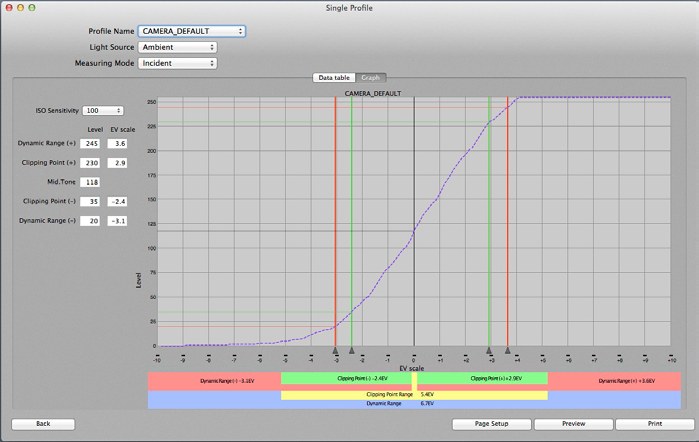
Once we had upgraded the meter firmware however (and given up on updating the desktop application), we decided to take a look at the other software features available to us on our Mac. Certainly you can more easily adjust the default settings (including things like colour scheme, dimmer delay, and auto power off that you are likely only to adjust once) and download to the meter via USB; however, we were looking for some real advantages not available on the unit directly. Among the most impressive features the L-478DR brings to the table, is the ability to profile up to 10 individual cameras, with customized exposure settings for each. The profiling utility looks a little daunting at first, but is actually quite easy to get the hang of… and extremely useful. Enabling photographers to store the unique dynamic range and clipping points of their bodies in memory, the meter graphically depicts these at the bottom of the display to ensure the current measurement falls within bounds. As a result, the L-478DR empowers the user to shoot with confidence, knowing their exposures are going to be spot-on… every time. Very cool indeed.
In Operation
To test the meter, we decided to put it head-to-head against its predecessor, the Sekonic L-358, as well as the iPhone app, ‘Light Meter’. Of course this latter competitor is unable to trigger flashes, and thus of pretty limited utility in the studio. However, as a tool to measure ambient light out in the field, we wanted to see how it compared — as you mightn’t always have your trusty Sekonic on-hand.
Over the course of our evaluations, we discovered that in the studio, the L-358 and the L-478DR provided pretty much exactly the same readings — even down to precise percentage displays of mixed strobe and ambient light. So no real advantage there… however, where the L-478DR really began to shine over its older sibling was by employing a combination of two features: the Contrast Function, and Radio Triggering and Power Control.
First, we used the contrast function to measure the evenness of light across our backgrounds — that’s fine, we could do this with the L-358 too — but instead of running back and forth to our lights and making adjustments to compensate, we merely used the strobe power slider controls on the meter directly! Employing wireless technology by Pocket Wizard, the L-478DR is able to control firing and specific power levels for compatible strobes over 32 channels, in four discrete zones. Further, this allowed us to obtain levels and set precise lighting ratios for our portraits, quickly and easily. This is a great feature, and saves a ton of time.
Moving outside and abandoning our flashes, we discovered the L-358 provided readings very slightly different than its younger brother, resulting in shutter speed recommendations of up to 1/10 of a second faster for the same aperture setting in some low-light conditions. Upon examining the exposures, we felt the L-478DR more accurate, and surprisingly, the iPhone app concurred more often than not… good to know!

In an effort to prove the thesis outlined in this issue’s Photo Philosophy column regarding the superiority of hand-held incident meters versus those resident in camera bodies, we took this shot of friend of the magazine, Irvis Mabel. Here she is, demonstrating a difficult lighting situation: standing in shadow with an extremely bright background containing sunlight reflected off the ocean and a bright sky. We weren’t using flash (though to obtain a balanced exposure you’d have wanted to) because we wanted to see what kind of natural subject exposure results we’d obtain using matrix, spot, and centre weighted metering on the camera versus obtaining an incident measurement from the meter… and let’s face it, you don’t always have a flash with you.
As anticipated, the L-478DR performed perfectly the first time, providing good subject exposure and blowing out the background, while the on-camera meter struggled. Matrix failed totally, providing an extremely under-exposed capture in an attempt to balance the scene. Centre weighted was marginally better, and in this case spot provided the best of the three. Still, the meter provided the best results and we were happy, if not surprised, to see our assertions proven true in a real world example.
Other Advantages
When compared to the L-358, the L-478DR does indeed have quite a few new features that I will actually use (despite having tons that I likely won’t… your mileage may vary). First there’s automatic filter compensation. They’ve included standard values for a variety of filters, and even enable you to apply them in a pack of up to 4 at a time. So I can select for example, CTO Full (see the Light Modifiers article elsewhere in this issue!), and be confident my exposure settings are taking this into account.
Further, the meter also allows the photographer to set static values for both shutter speed and aperture, and provides the correct exposure using ISO. This is very handy when you want exact control over depth of field while maintaining a minimum shutter speed for action shots, and surprisingly, not a feature available in the L-358. Finally, the touch-screen interface provides much improved access to all the meter’s features — which is certainly better than having to manipulate dip switches located in the battery compartment of the L-358!
Recommendation?
So should you pull the trigger on a shiny new Sekonic L-478DR? Well that depends… If you own strobes that feature Pocket Wizard technology for wireless control, then the answer is an emphatic yes! If you own multiple camera bodies and frequently employ several in a shoot, then yes!
If you don’t, and already own an older meter, your decision is tougher, as the differences, while considerable and certainly not entirely covered by this review, may indeed be just what you’re looking for… or may not. It’s up to you to justify the expenditure for additional or improved features gained thereby. If, on the other hand, you don’t already own a meter (and you should!), you can’t go wrong with the L-478DR, retailing at approx $469 USD. We heartily recommend it.