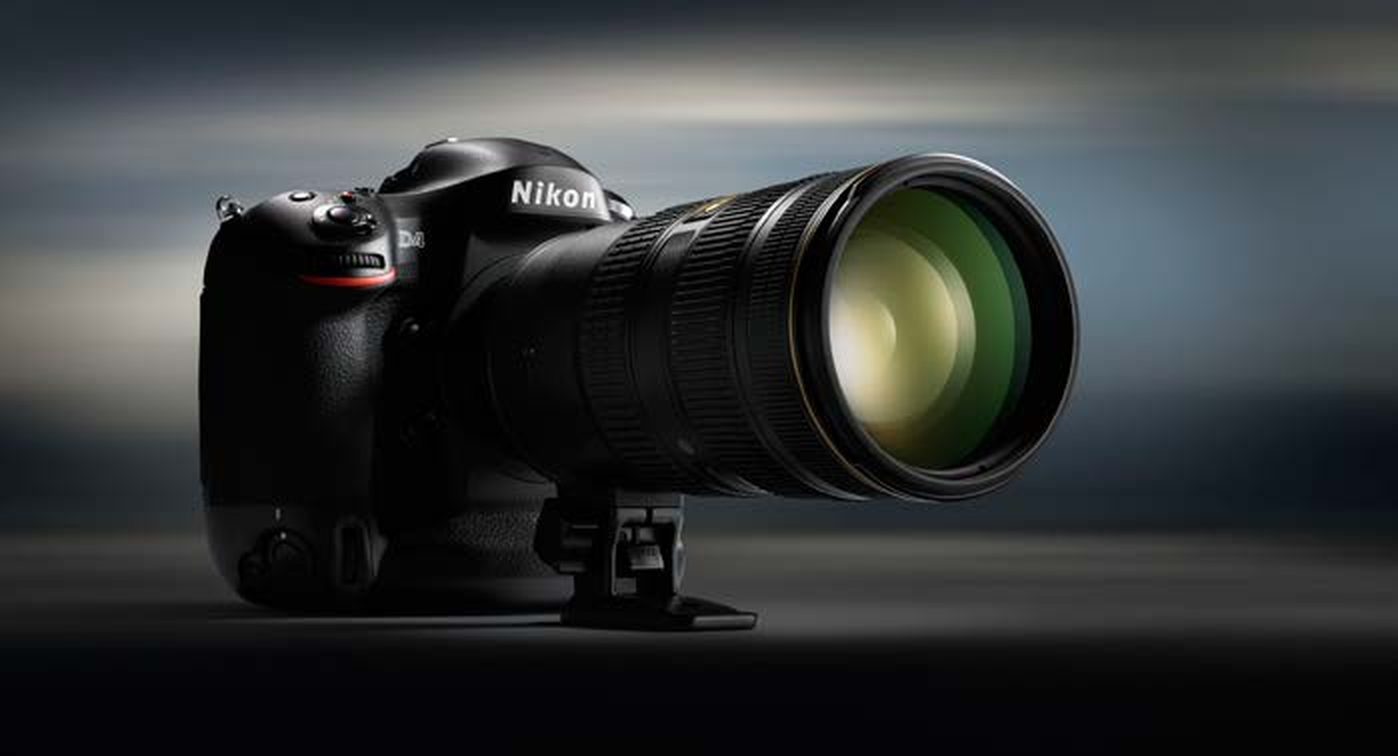
It’s been busy in the photographic equipment manufacturing world! Nikon has been particularly active, releasing both the eagerly anticipated update to its flagship professional DSLR with the D4, and an equally strong contender in the pro/prosumer segment with the D800. Both of these cameras offer a stunning array of features designed to make even the most jaded reviewer drool.
For starters, Nikon’s new top-dog finally supports full 1920×1080 video at either 30 or 24 frames per second, dramatically improving on its predecessor’s 1280×720@24 fps spec. In addition, the inclusion of a stereo mic input further enhances this product’s suitability for producing broadcast quality video. There is a limit of 20 minutes recording time at the highest quality setting; however, in real-world video shoots, single takes seldom run anywhere close to that amount of time. If you do find yourself requiring more recording time, you can output via the integrated HDMI port to any external recording device.
While on the subject of frames per second, the D4 has improved this spec to a blistering 11 (with AE and EF locked, 10 otherwise), at up to 98 RAW files in a burst! This is achieved by way of Nikon’s implementation of Sony’s new XQD standard for storage — which supports file transfer speeds of between 125 and 500 megabytes per second, and capacities over 2 terabytes. While, like its predecessors, the D4 comes equipped with 2 card slots, it now includes both a standard compact flash as well as the new XQD variety, and is the first camera on the planet to adopt the standard.
Smart Storage?
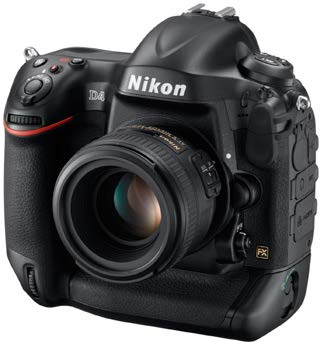
It remains to be seen whether this has been a prudent decision for the company, as no other card manufacturer has as yet announced intentions to produce XQD format products, and users may be limited to purchasing storage via the Sony monopoly. Not only this, but should photographers wish to utilize functions which take advantage of both slots (automatic backup, continue on to second card after first is filled etc.), they will have to own and carry both types of media — with vastly different storage characteristics.
While slightly larger than the D3 line, the D4 is lighter, and further improves on that former unit’s already outstanding ISO performance: featuring native settings of between 100 and 12,800, with LO and HI options of 50 and 204,800 respectively. This is a vast improvement over the D3 and still significant when compared to the D3s — particularly for landscape photographers who often desire lower ISO range availability.
At the high end, you should never have to worry about shooting in low-light again, especially as the manufacturer also promises accurate focusing in environments similar to moonlight alone, with the advent of the new MultiCAM 3500-FX autofocus sensor. With 15 cross type sensors out of the unit’s 51 in total, the centre 11 are able to autofocus up to f/8 — besting its predecessor’s performance by a full stop. Working in conjunction with the Expeed 3 processing engine, the D4 offers several autofocusing modes, including normal, wide area, subject tracking, and face detection capable of tracking up to 16 individual faces simultaneously.
The camera also features significantly more in-camera image processing options including colour sketch, miniature, fisheye, red eye correction and the like. Not big fans of on-board effects, we feel that perhaps some may gain some utility from them, but they certainly aren’t big selling features. Few willing to invest $6000 on a professional camera are going to add canned, in-camera effects to their workflow — opting rather for the increased precision afforded by equally professional image processing applications viewed on a large, colour calibrated monitor in a controlled environment.
Ergonomics
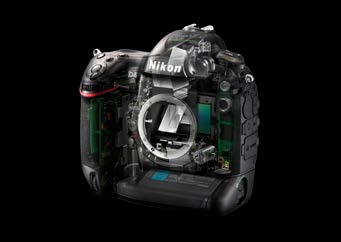
Nikon has always been known for its outstanding ergonomics, and the D4 is no exception. The camera fits like a glove to anyone comfortable with larger, pro bodies. In addition to the usual excellent weather sealing with gaskets to ward off dirt and moisture, the unit also purports to guard against electromagnetic interference.
Not only has the company refined its button layout, it has added the option of illuminating them for shooters that work in near-dark conditions. Also new to the D4, a joystick control on the rear of the body enables users to select autofocus points with ease. The viewfinder is also typical of Nikon’s pro line: bright, with comprehensive shooting information and 100% frame coverage.
Decisions Decisions…
So, now that you’ve been apprised of the specs, how do you determine whether this camera is worth the upgrade price? Well, at $6000 for the body alone, the target market is obviously the working professional photographer. As most pros write off their equipment over a few years from a tax perspective, the decision of when to upgrade is relatively straight-forward. For those with an original D3, the choice to move up is an easy yes; while for those with a D3s, it’s a little tougher to make the call.
Less time has passed since the D3s’ release, and so you might find you’ve not depreciated that equipment as yet… and the upgrade is also less dramatic. ISO performance, while improved, isn’t vastly different in most situations. Video specifications are definitely better; but the D3s was certainly no slouch — and how much video do you actually shoot anyway? Battery life is actually reduced due to new restrictions placed on manufacturers; and the memory card situation as outlined above may result in unforeseen difficulties for D4 owners should the industry fail to adopt the standard.
All in all, the camera seems more of an evolutionary upgrade from the D3s, rather than the revolutionary jump the D3 made from the D2xs; but for those that simply need the best of the best… look no further.