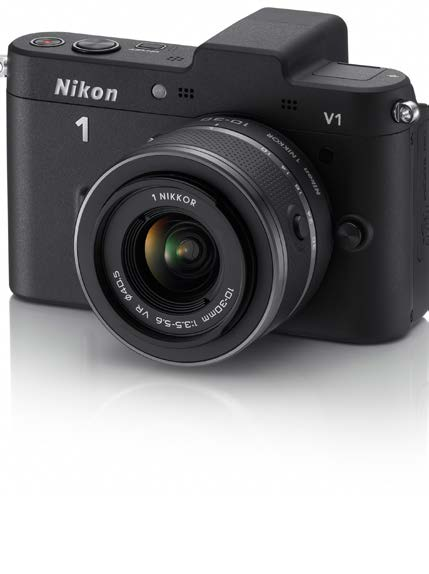
For many photography novices, DSLRs are too large, cumbersome and complicated. While point-and-shoots are designed to have none of these issues, they often lack the picture quality, responsiveness, and flexibility afforded by their larger cousins. The flip side of the coin is represented by DSLR lovers who wish to have the high degree of portability afforded by the point-and-shoots, but also retain image quality, flexibility, and control they have grown accustomed to.
With these desires in mind, Nikon launched its ‘1’ series, whose two models include the J1 aimed at the consumer, and the V1 at the pro and prosumer markets. So is the ‘1’ series the best of both worlds that Nikon hoped it would be seen as? Is it the porridge that Goldilocks would have selected? Let’s find out!
Methodology
Upon our request, the company was kind enough to send us the V1 in addition to all the lenses that are currently available for the unit: a 10-30mm f/3.5-5.6, 30-110mm f/3.8-5.6, and a 10mm f/2.8 prime. To evaluate the camera properly, we felt we should review it from both perspectives as detailed above: the point-and-shoot consumer that wants better image quality, and the DSLR user wishing for more portability. To this end, we engaged the services of an individual from outside our team who volunteered to test the V1 from the consumer angle.
Ann currently owns an older model Canon (Powershot SD700 IS) point-and-shoot; and is becoming increasingly disappointed with the results it yields when compared images of the same scenes produced from the DSLRs her friends own. She isn’t interested in bulky, complicated equipment however; she just wants better images from the camera she brings with her to family events and on holiday.
We loaned the V1 to Ann for a week, asking her to give it a whirl to see how it would fit into her lifestyle and photographic requirements. She was delighted to do so, as she had actually been contemplating purchasing the unit in advance of our request, and would now have a thorough try-before-you-buy experience.
Ann’s Impressions
As Nikon hadn’t included the manual or quick-start guide in their shipment to us, Ann found herself at a bit of a loss at the outset. She managed to power up the unit, but couldn’t get it to focus on anything, as she was unaware the zoom lenses require you to press the button and extend the lens from its retracted position in order to function. We subsequently found a PDF manual online and downloaded it to an iPad to get her up and running. She studiously read the entire (quite lengthy and comprehensive) file, and was thereafter in a much better position to give the unit a proper evaluation.
She spent the week shooting images of her grandchildren, activity at the harbour, wildlife and so on, as well as short video clips of the same. We received the camera back, examined the contents of the SD card, and asked Ann for her thoughts:
DP: So, Ann, you’ve had a week to evaluate the V1. What were your initial thoughts regarding the unit?
Ann: Well, there were some things I liked and some things I didn’t…
DP: What did you think about the image quality of the photographs you produced?
Ann: I thought it was good; I didn’t think it was that much better than what I already have. You know, for the increased bulk and the lack of flexibility with having to carry around the lenses, I just didn’t think it was worth the improvement in photo quality. One thing I really did like was the rapid shutter where you can get a whole bunch of pictures at once. You know one of them is going to be a great picture. I really liked that. That’s the one thing that I don’t have on my camera that I really would like to have but it still really wasn’t worth the difference in price — but it really wasn’t the price, it was the bulk of the camera.
DP: Well speaking about that, how about the responsiveness? Were you able to get the shots you wanted fairly quickly and easily?
Ann: No. It seemed the lens that I needed was never on the camera in that moment. I’d see something off the balcony, like an eagle going by, and I’d want to take a shot. You know, with my old camera it may not be as good a picture but I can just pick up the camera and click. I can zoom quickly, and can quickly have a flash or no flash. I couldn’t do that with the V1. The response time just wasn’t as good for me.
DP: How do you feel about the ergonomics of the camera?
Ann: A little bulky. There’s another thing too — and I don’t know if I just wasn’t doing it right — the on/off switch was confusing. The light didn’t stay on and so I didn’t quite know sometimes whether the camera was on or off.
DP: How did it feel in your hands?
Ann: A little clunky. You had to be careful where you put your fingers — not to put them in front of this, or touch that — it just wasn’t great.
DP: Were there any particular features you thought were quite useful?
Ann: Yep, I liked the fact that it focuses on faces, the quick shutter speed was a big thing for me. The other thing I liked was that it did take much better pictures in low light. That was a big deal. I really liked that. There was an obvious and significant improvement there.
DP: Any features or aspects of the camera that you could do without?
Ann: I didn’t like the tips flashing up in front of your face (although I know you can turn that off), I didn’t find that useful at all. I didn’t find that the zoom — I know it’s better than my camera — but there wasn’t enough of a difference to make me want to switch. I could also do without having to switch the lenses all the time. I would like it if you had the option to even have a minimal flash there when you need it without having to put one on. I wasn’t even working with a flash attachment — I didn’t have one — but that would just be one more thing to be carrying around and fumbling with.
DP: Well the J1 does have a built-in flash, but there again, it doesn’t have the viewfinder which is something that you had wanted as well…
Ann: Yeah, I wouldn’t want to do without the viewfinder. The viewfinder was good.
DP: What about the form factor — do you find this camera would fit into your lifestyle in terms of portability and versatility?
Ann: There were several times that we went out on hikes, and I was going to take pictures. I had that camera, and I actually thought of taking it, but I just didn’t want to lug it along with all the lenses and everything — and on a hike I don’t want to be worried about dropping lenses, you know?
DP: How does it compare to your Canon overall?
Ann: Not enough of a difference to make me want to buy it.
DP: And how old is your Canon?
Ann: I think it’s about 5 or 6 years old?
DP: Did you learn anything about yourself as a photographer while using this camera?
Ann: Yes, I did. I learned that pictures aren’t as important to me as I thought they were. I do want to take nicer pictures; and I do like taking pictures; but for me, I realized that taking pictures is more a part of the experience, it’s not the experience. I’m not going out to produce great pictures; I’m going out to have a good time and capture memories on the camera — I realized that. If I was a photographer, or even if it was more of a hobby than it is now, I might want to take that camera to go out specifically to take pictures; but I realized that’s not what I use my camera for. I use it to capture memories; and what I have does that pretty well. You know what? In that case, the camera would be the experience, not the event that you’re trying to capture. That’s how I felt.
DP: Ok, so I suppose the last question would have been “would you purchase one?”, but I guess you’ve already answered that for us.
Ann: No I wouldn’t, which is really great because I probably would have gone out and purchased that camera if I hadn’t had the opportunity to try it. So it was a learning experience for me actually. I learned what I need is a point-and-shoot, or something that was in-between those two where I didn’t have to switch lenses all the time… where I had a basic option that did most of the things that I need to do, and if I wanted to take special pictures, then I could put on the odd lens. But with that one, without having all the lenses along with you, you’re really held back too much.
The Flip Side
Ok, well that wasn’t exactly a ringing endorsement. To provide a counterpoint to Ann’s perspective, I decided to give the V1 a whirl myself. As Editor of DarkroomPro Magazine, I get to try a lot of photographic equipment, and felt my view would likely be significantly different from that of the average consumer, given my exposure and familiarity with all the gear on offer.
Normally I shoot a Nikon D3; though I do have several other bodies ranging all the way down to a little D50 which I use when portability is paramount. Still, the D50 can be bulky at times, so my interest in the V1 and its promise to provide DSLR comparable imagery in a small form factor was pretty high. Unlike Ann, I don’t have issues changing lenses, though I am also often seen using two camera bodies equipped with lenses of differing focal lengths when I need a speedy response to whatever is unfolding before me.
First Impressions
I’d read all the specs in advance of receiving the camera; but specifications often don’t inform as to the experience one is likely to have with a new piece of equipment. I found this definitely the case with the V1. Everything seemed unfamiliar, with the exception of the menuing system, and I even spent over 5 minutes (having no manual at the time) trying to figure out where exactly to insert the memory card (the slot is in the battery chamber). I too was confused by the focusing system, but got used to it in fairly short order. So after working with the camera for a week, here’s what I found…
What’s Hot
The camera packs a ton of interesting features into its operating system, one of the best being the ability to select between mechanical and electronic shutter — enabling 5 frames per second in the former mode, while providing access to 10, 30, and even 60 fps in the latter! This is fantastic for action shots involving sports or erratically moving subjects like children.
Another use of this high frame rate is built into one of the camera’s primary modes: Smart Photo Selector. This setting takes a short burst of images and automatically selects the best among them (in the camera’s opinion of course) to display for your approval. You may elect to choose another image from the stack if you wish; however, I found the camera was pretty good at selecting the best of the bunch. This is a great feature for those moments when you’re trying to capture a fleeting expression, or avoiding blinking etc.
Movie mode is where this camera stands out from the rest. Featuring full 1080p video capture and a built-in stereo microphone, the V1 has some other tricks up its sleeve utilizing the electronic shutter: slow motion at either 400 or 1200 frames per second! Of course, at these speeds, resolution has been reduced to 640×240 and 320×120 respectively; however, the effects are quite dramatic and a lot of fun to play with!
The display is bright and crisp, sporting 921,000 dots and the viewfinder is actually another LCD display which is automatically activated upon proximity to your face. For shooting video outdoors in bright conditions, this is definitely a welcome advantage, as DSLR video is typically only available for viewing on the rear screen, while the viewfinder itself is disabled.
What’s Not
Obviously, from an ergonomic perspective, the camera takes some getting used to — given my experience is primarily with full-sized bodies. Still, the V1 felt uncomfortable in my hands, having too many tiny controls for me to deal with in the week I was working with it. I found I was constantly looking away from the viewfinder to adjust this or that, and that many of the functions I wished to access were buried in the (quite well thought out and designed) menu system. I’m sure I’d eventually become accustomed to the controls; but I don’t feel I should have to work at something that should become second nature to a seasoned photographer after a week of use.
Ergonomics aside, I was prepared to be dazzled by the image quality Nikon purports the camera to be capable of. Taking a few test shots in a variety of lighting conditions, I was surprised to see that even at ISO 100, there was frequently noise in the shadowed areas of the photograph. I wasn’t expecting this. Certainly the noise was typical of Nikon: not unpleasant and rather film-like; however, this is not what I would be hoping for from a camera body in this price range. The tiny sensor is clearly to blame here. Packing 10 megapixels onto a 13.2×8.8mm sensor is quite impressive; but if it yields unsatisfactory results, it’s rather a wasted effort. Other compact cameras in this category feature significantly larger sensors and thus are less prone to this difficulty. On the other hand, white balance was very good, and the colour accuracy equally so… thus, not an entire loss.

Conclusion
So, is the Nikon V1 a panacea for the problems it seeks to address in its two target markets? It’s a good effort, but sadly no. We feel it’s a great start and look forward to the next iteration, but here Nikon seems to fall short of the mark in too many areas for us to give it a whole-hearted recommendation. Certainly the camera has its strengths, and for many, its shortcomings will not prove as problematic as they were for our testers. While not able to give this particular version a thumbs-up, we applaud Nikon’s first endeavour here, and expect great things from the company in future.