These days, life has become so cluttered and busy, it’s easy to forget to take the time to enjoy the restful silence which may be afforded one in the endeavour or appreciation of photography. The medium enables an individual to step back and isolate the essential and important, from that which is more appropriately described as background noise. A key component in this pursuit as applies to photography, is the skillful utilization of what’s known as negative space.
What’s That All About?
Employing negative space is about using the blank or nondescript area around a subject used to give more prominence to that subject. Effective use of negative space in photographic terms is accomplished via a number of techniques; preeminent among them, the use of large apertures in support of achieving shallow depths of field, rendering non-subject elements of the frame as a blurred backdrop. This works well in scenes wherein the dominant feature of the capture, aside from its subject, is busy and colourful — a canopy of trees for instance — and provides an effective canvas upon which the photographer may highlight his muse.
You’re not using negative space should these elements be distinguishable as potential secondary or tertiary subjects; as using this technique is all about the isolation of the subject against a calm and mostly uniform backdrop, using depth of field in this case to achieve this effect.
Of course, widening your aperture isn’t the only way to go about working with negative space. The technique is about stripping away the non-essential to reveal the subject’s qualities in a minimalistic context. This can involve use of plain paper backdrops in the studio, shooting against a clear sky, large expanses of water, brick walls and the like… anything that allows you to reveal your subject without distraction.
Fill the Frame?
The mantra of many well respected photographers is that it’s generally better to ‘fill the frame with your subject’. They advocate zooming well in, tight crops, more weight, less cruft. While certainly this technique has merit, there are often occasions where a photograph is substantially more powerful when the subject is given the space it needs to express its significance.
Let’s say you want to express the idea of ‘small, but important or essential’ in an image; wouldn’t a great way to accomplish this be to feature the subject in a rule of thirds position, but only occupying a small fraction of the frame — the rest devoted to a blank canvas? The subject is drawn into sharp focus and actually has more weight due to the contrasting void that surrounds it.
Design Decisions
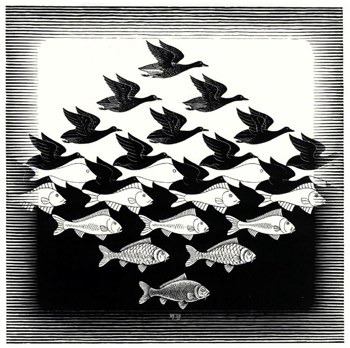
Negative space can not only highlight a subject, but define it. We’ve all seen the famous image which depicts either a vase, or two faces looking at each other — which one the viewer sees, depends on what they perceive as the negative space in the scene. Take the M.C. Escher sketch above for example… the negative space not only helps define the subject, but makes a transition in both directions to actually become the subject. Designers frequently utilize this technique to subtly convey a message in a clever manner.
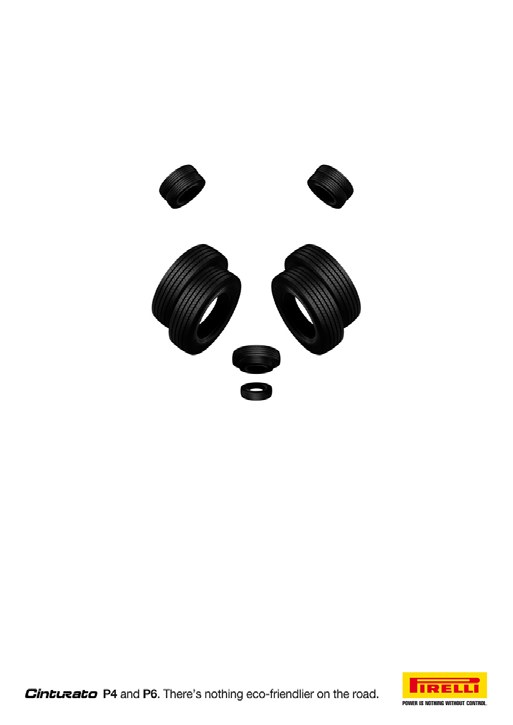
Designers aren’t the only ones that can pull this off however! Check out this brilliant ad for Pirelli Tires which employs the negative space in the scene to define the panda and convey their eco-friendly message. Careful framing of your subject can often lead to some extraordinary results if you pay as much attention to what’s around it as to your primary target.
Handy Hints
There are a few things to keep in mind when exploring the use of negative space in your photographs. For example, if you are using a human or animal subject, pay attention to their direction of motion and sight lines. It’s generally best to give them some room to move into within the frame… so provide some negative space in the direction they are traveling. Additionally, you’ll typically want their eyes to be looking into the white space [term for negative space used primarily in advertising] area of the image.
Failure to adhere to the above can lessen the restful appearance of your photograph — though this may be a creative decision undertaken to instil visual tension [see issue 2 for a complete discussion of visual tension!] in the image. Breaking the rules can be fun and lead to interesting results, just ensure you do it in order to achieve an artistic end, not because you weren’t paying attention!
So, as you’ve seen here, what’s not the subject of your photograph can be equally important as that which is. Negative space is an interesting and essential tool to utilize for any photographer; and knowing how best to exploit its potential in any situation can transform what might otherwise be a simple snapshot, into a work of art.